
The U.S. incidence of dementia is forecast to more than double by 2050, and it is becoming imperative for primary care providers to be able to help with initial diagnosis or at least screening for this illness. However, while patients want to discuss their concerns about memory with their trusted medical advisers, primary-care clinicians say they need more training to be able to diagnose cognitive decline or at least determine whether someone should see a specialist for testing.
Dr. Barak Gaster, a dementia expert and primary care physician at UW Medicine, is building a program to help healthcare systems meet this need. He has found that many primary care doctors feel like they need more knowledge, more confidence and better tools when a patient says, “I might be having memory problems.”
The Cognition in Primary Care (CPC) program (https://familymedicine.uw.edu/cpc/) blends brief education modules with easy-to-use electronic health record tools to put the training into practice. UW Medicine has offered the course to all of its primary-care clinicians across greater Seattle. Dr. Maisterra, an early adopter, said, “It’s user-friendly, which I think is because these (content creators) are people who understand that our day-to-day job leaves us about 10 minutes to learn something new.”
The aims of this program are to:
- Provide education for primary care to efficiently evaluate cognition, identify cognitive impairment, and improve patient care.
- Improve connections between patients, families, and community resources.
- Develop clinic-based tools and workflows which are adapted from the GSA-KAER Toolkit.
Dr. Maisterra said the content was broken into three digestible parts:
- identifying patients at risk, screening for red flags and modifying risk factors
- testing in more detail to establish a diagnosis, and providing a referral if appropriate
- offering follow-up treatment, support and ongoing surveillance, in primary care or with neurology
She described a patient who benefited from the primary-care visit with her, which was able to happen sooner than a visit to see a specialist, whose schedules are often full. The woman’s family had been concerned about her memory lapses. The primary care doctor was able to determine that she did not have cognitive impairment. Instead, she needed hearing aids, needed to resume using her CPAP, and needed some medications adjusted which might have been contributing to her cognitive symptoms.
The Cognition in Primary Care approach has a plan for the primary care doctor to follow to evaluate cognition. The three main components of the visit include:
1. Screening for reversible causes and contributing factors (possibly using an Electronic Health Record Cognitive Checklist).
2. Get family input (and strongly encourage an observer who knows the patient to attend the visit).
3. Assess cognitive function with a MoCA (Montreal Cognitive Assessment), a rapid screening instrument for mild cognitive dysfunction.
Ideally, all primary care physicians should be trained in these diagnostic skills, especially since dementia cases are increasing so rapidly. Such a volume of cases could be far more than what can be managed by neurologists and geriatricians, the typical specialists in this area.
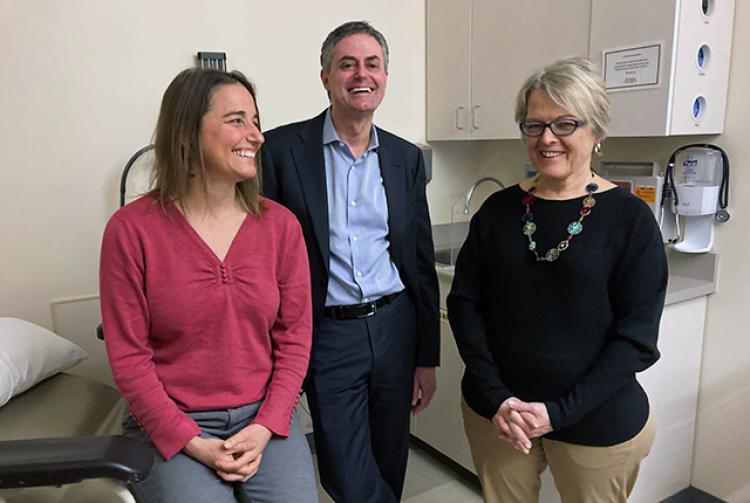
Photo Credit: From left, Drs. Jacqueline Raetz and Barak Gaster used funding obtained by Annette Fitzpatrick to develop the Cognition in Primary Care program. Credit: Brian Donohue / UW Medicine